• Skip to primary navigation
  • Skip to main content
  • Skip to primary sidebar

StronGains

Great Strength Training Exercises

  • Home
  • Videos
  • Stomach Muscle
  • Strength Training
  • Leg Workout
  • Arm Workout

Blog

How to Do Dumbbell Lunges

September 1, 2015 by Strongains

Dumbbell lunges are a great exercise that strengthens your quadriceps and also offers some exercise to synergistic muscles such as the gluteus maximums, adductor magnus and soleus. Because this exercise is performed using free weights, rather than a machine, you are forced to recruit stabilizing muscles too. The stabilizing muscles recruited in your legs include the hamstrings and gastrocnemius. In addition, your core is employed to help you keep the right posture, recruiting the erector spinae, upper and lower trapezius, levator scapulae, tibialis anterior, obliques, gluteus minimus, gluteus medius, and quadrates lumborum. As you can see, if you perform these lunges correctly and with an appropriate weight you will find that it strengthens and tones your entire body

dumbbell-lunge-young-man-exercising-lunges-weights

Performing a Lunge Correctly

To perform a lunge correctly, take two equally weighted dumbbells, and stand with them grasped by your sides. Lunge forward with one leg, landing on your heel and rolling down onto your forefoot. Lower your body slowly by flexing the knee and hip of your front leg, drop your weight slowly until the knee of your rear leg is almost touching the floor. Hold there for a second or two then raise yourself back up to a standing position by extending the hip and knee joint of your front leg. Repeat the motion by stepping forward with the opposite leg. This counts as one full repetition.

Be sure to keep your torso upright while you are performing the lunge. Keep your leading knee pointing in the same direction as your foot throughout the motion. Lower your weight slowly so that you don’t damage your hip flexors. Choose a weight that will leave you fatigued after 10-20 repetitions, but that is not so heavy as to impair your posture.

Progression for Dumbbell Lunges

These lunges are a good exercise for beginners because they place less stress on your knees than a full squat, while still offering a good workout. If you have not done any exercise before, you can start by doing unweighted lunges, and then gradually working up to performing the exercise with a weight in each hand. If you have tight hip flexors, warm up and do some gentle stretching to loosen them up before you try this exercise.

You can target different muscles with dumbbell style lunges. A long lunge puts stress on the gluteus maximus, while a shorter lunge places the emphasis on your quadriceps. If you do not feel comfortable working with a lot of weight, you can perform the exercise with a lower weight and walk up and down the mats as you lunge. To build stamina, try holding the position at the bottom of the lunge for as long as you can.

Once you feel confident in your strength performing these lunges, consider moving on to squats, deadlifts, leg curls or other exercises that involve slightly more weight. Always warm up before performing any exercise that involves heavy weight, and be mindful of your form. Stop the exercise if you experience any pain.

Filed Under: Leg Workout, Strength Training Tagged With: dumbbell lunges

Tips for the Snatch Grip Deadlift

August 31, 2015 by Strongains

strong-man-deadliftsThe snatch grip deadlift is a popular compound lift that is used in Olympic weightlifting. This lift primarily targets the hamstrings, but it also works the forearms (for gripping the bar), the glutes, hamstrings, quadriceps, traps and lower back.
This deadlift is an intermediate difficulty compound lift. It is generally considered to be safer than a straight-legged deadlift, but you should still take care to perform the lift correctly because if you do not maintain good posture during the lift you can injure your back. The snatch grip can be used as a one-off lift, or as an accessory for training the strength of the first pull of the snatch.

How to Do A Snatch Grip Deadlift

To correctly perform this lift, stand in a wide snatch grip with the barbell placed on the platform. Start with a light weight that still allows the barbell to be at the right height for you to grab. You may need to use rubberized bumper plates to be able to achieve the right set-up. Make sure that your feet are directly underneath the bar. It is common for people to not stand “deep” enough, and this leads to poor posture.

Squat down towards the bar, being sure that you keep your back extended with your head up and looking forward. Under no circumstances should you ever round your back when performing a deadlift.

To start the lift, drive down through your heels and raise your hips. Keep your back at the same angle throughout the first portion of the lift, do not allow your back to round.

Once the bar passes your knees, drive your hips forward through the bar and lay back. This will straighten your back and complete the lift. Do not try to “hitch” the bar up your legs. If you feel the need to do this then the weight you are lifting is too heavy.

Return the bar to the floor by reversing the motion you have just performed. If you feel that you cannot safely do this, and you are lifting in a gym with bumper plates and a deadlift platform, you may be able to simply drop the weight. However, this is often frowned upon because it can damage metal plates, damage the floor, and even potentially injure bystanders of the weight rolls or bounces. Try to stick to a weight that is heavy enough that you are tired after five repetitions, but light enough that you can pick it up and put it back down in a safe and controlled fashion.

A deadlift repetition involves picking up a weight then putting it back down and allowing it to come to rest on the floor. Do not bounce the weight up and down off the floor between repetitions. Stop after one repetition, take a moment to address the bar again and perform the next repetition correctly. Deadlifts are best performed as a heavy lift for a low number of repetitions.

Filed Under: Leg Workout, Strength Training Tagged With: snatch grip deadlift

Strengthen Your Core With The Reverse Plank

August 29, 2015 by Strongains

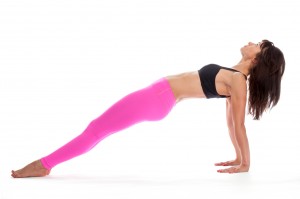
The reverse plank is a great bodyweight exercise for strengthening your core and your posterior muscles. If you perform the exercise correctly, it will isolate and strengthen not just the gluteal muscles but also your hamstrings, abs and lower back. Many people use this workout as a part of a warm-up, but it can also be used to stabilize your core and spine, and is good rehabilitation for people with back problems; assuming, of corse, that the movement is performed with proper form.

pretty-woman-yoga-pose-reverse-plank-positionTo perform this exercise, sit on the floor with your legs out in front of you, and place your palms on the floor slightly behind your hips. Spread your fingers wide and press into your palms, lifting your hips so that your torso moves up towards the ceiling.

Keep looking at the ceiling, and point your toes. Make sure that you keep your arms and your legs straight. Hold your entire body strong so that you are making a straight line from your head to your heels, and squeeze your core. It should feel like you are trying to pull your belly button towards your spine.

You should aim to hold the reverse plank for 20-30 seconds per repetition. If your hips drop or you feel like your stomach is starting to sag, lower yourself back to the floor immediately. You will not be getting any benefit out of holding the wrong position, and you could actually be leaving yourself open to risk of injury.

More Advanced Versions

Once you have mastered the standard reversed plank routine, you can try to make the plank more difficult. There are several ways you can do this. One option is to wear a weighted vest while performing the plank. If you do this, start with adding just 5 or 10lbs of weight and gradually increase the amount of resistance you use.

Another option is to do one-legged planks. Raise yourself up into a normal reversed plank position, and then once you are in place lift one leg off the floor and keep it straight out in front of you. Hold the position for as long as you can, keeping your posture tight and the elevated leg as straight as possible. When you experience fatigue, lower yourself back down to the floor and repeat the process, elevating the other leg.

Planking is a low impact exercise that builds strength and endurance and offers a good full body workout. This workout is an intermediate level exercise, and it should be performed with care. Do not do this exercise if you have back problems or are otherwise injured. Always warm up before exercising, and focus on holding good form throughout the exercise. If you feel that you are not yet strong or flexible enough to perform a full plank, try performing a similar motion but supporting yourself on your elbows instead of your hands. Gradually increase the length of time you hold the position and work up to the full version of the exercise.

Filed Under: Health & Fitness Tagged With: reverse plank

  • « Go to Previous Page
  • Page 1
  • Page 2
  • Page 3

Primary Sidebar

Copyright © 2026 · StronGains.com

  • About
  • Contact Us
  • Terms of Use
  • Privacy Policy
  • Curation Policy
  • DMCA Policy